This text is a translation of the article originally published in French on October 11, 2021. The quotations and references correspond to the French edition of Lady Sapiens. One can also consult the particularly informed review written by Fabien Abraini (using the Google translate module)
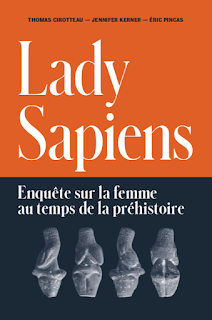
The idea that prehistoric — actually Paleolithic — women have been demeaned by centuries of misogynistic prejudices, and the need to rehabilitate their real social role, is nowadays a seemingly inexhaustible source of inspiration. The latest avatar of this trend, Lady Sapiens, a multi-faceted work that combines a video game, a documentary and a book, has received wide media coverage. While the film was played on a public channel at prime time, the authors are invited to promote it in various shows, and the book, for which translation rights have already been bought in several languages, is promised to be a great international success. At first glance, for anyone concerned with both the emancipation of women and the promotion of scientific knowledge, there is nothing but cause for rejoicing. However, it must be said that far from presenting a balanced state of knowledge on gender relations in the Paleolithic, Lady Sapiens conveys a picture marred by serious biases.
Let’s look at a text described as “nuanced”, and from which “any kind of militant discourse (…) has been banished in order to reach the greatest possible objectivity”. (p. 13)
Presentation
Lady Sapiens is a collective work. Thomas Cirotteau and Eric Pincas, two journalists who have already worked on the distant past of humanity, interviewed a series of scientists, some of them highly qualified and renowned. From this mass of material, they have drawn the documentary. The book, for its part, was written from the same elements by Jennifer Kerner, doctor in archaeology and host of a YouTube popularization channel (Boneless). Finally, all this work was conducted under the scientific supervision of Sophie A. de Beaune, professor of prehistory at the University Lyon 3 Jean Moulin.
Both the documentary and the book use a well-tried process of popularization, by unfolding a presentation articulated around short quotations from the scientists interviewed. Attractive, knowing how to use the right amount of storytelling, the book is furthermore embellished with beautiful illustrations, made by Pascaline Gaussein. As far as the form is concerned, it is an irreproachable success which, as well as the documentary, could have represented a first-rate tool, if only it did not paint an image of the situation of women which corresponds much more to a contemporary fantasy than to the state of scientific knowledge. The woman of the Late Paleolithic is thus described as an emancipated working woman, choosing her partners, controlling her fertility, having access to more or less the same activities as men and exercising social influence on an equal footing with them. In order to achieve this result, despite the rhetorical devices that give the superficial impression of a balanced investigation, the presentation in fact endeavors to systematically dismiss all elements that might suggest the probability (or even the mere possibility) of male domination, either by mentioning them in a more or less disguised way, or by resolutely ignoring them.
Yet, as soon as one undertakes the study of the condition of prehistoric women, the question of gender relations and that of male domination cannot fail to be asked, as anthropologists, ethnologists, historians, sociologists and other philosophers have shown their structuring power in social organizations. Of course, answering these questions in archaeology is not easy, the material traces left by our ancestors being rare — in particular for the Palaeolithic -, partial and difficult to interpret. But the clues exist nevertheless and it is therefore crucial to examine them with the greatest care, without omitting any. However, if, on several occasions, both the book and the documentary rightly insist on the importance of ethnographic comparatism in order to provide clues for the interpretation of certain archaeological facts, in practice, they evacuate the numerous observations that could be at odds with their statement.
A biased presentation : the gendered division of labor
The gendered division of labor has always been an essential dimension of male domination, and the contemporary feminist struggle rightly aspires to abolish it in fact as well as in law. Lady Sapiens strives to accredit the idea of its weakness, or even its non-existence, in the Late Paleolithic, 40,000 to 12,000 years ago, when groups of archaic homo disappeared and were replaced by biologically modern humans.
It therefore insists that women were hunting small animals at the time, or that they participated in collective hunts. As far as is known, this is most probably true. But, as the observation of all the hunter-gatherers known in ethnology shows, this fact did not prevent women from being the object of a series of prohibitions of a remarkable constancy on the five continents : they are indeed almost universally excluded from the handling of the most lethal cutting or piercing weapons, such as the spear or the bow, and thus from certain specific activities. Throughout the text, the participation of women in hunting is thus abusively presented as an indication of the absence of a sexual division of labor.
In passing, the documentary contains a surprising reconstruction of a mammoth hunting scene, in which the participants are equipped with bows : however, this weapon is only attested with certainty from the Epipaleolithic period, the oldest example found in an archaeological context dating from about 12,000 years ago. Some evidence points to its earlier invention, but this remains a matter of debate. In any case, except in the very particular case of the Agta of the Philippines, no population of hunter-gatherers observed in ethnology has ever allowed women to handle spears and bows and thus to intervene in the bloody killing of big game. There is therefore a bias in taking this people precisely as an example in the documentary… while omitting to specify that they obtained their vegetable products from neighboring farmers, and that they were therefore entirely specialized in the acquisition of meat food resources.
The treatment of archaeological information reflects the same imbalance. Let us remember that any gendered division of labor does not necessarily leave its mark on human remains : an archaeologist of the future would be at pains to identify from the bones many of the current professional specializations of women. By restricting ourselves to the Late Paleolithic of Western Eurasia, covering more than 30 millennia, the investigation is all the more arduous as only a very small number of skeletons are available, generally poorly preserved. Nevertheless, the pioneering study by Sébastien Villotte showed, a few years ago, that the right elbows of well-sexed males — and only they — bore the traces of repeated throws, which can easily be interpreted by a parallel with ethnographic observations in which thrown weapons, with the help of a thruster for example, are handled by men.
The authors of Lady Sapiens certainly mention this study… but quickly bring to the top the “extraordinary” discovery made a year ago by Randall Haas, which would have proved the existence of women hunters of big game in Paleolithic America. This is the sole basis for the claim that “some Upper Paleolithic women, on par with men, threw weapons to kill big game” (p. 235).
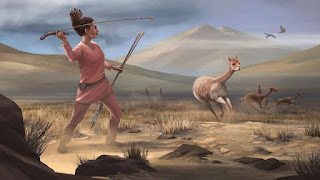 |
| The artist’s view illustrating R. Haas’ article, “Female Hunters of the Early Americas”, Sciences Advances, 2020, vl. 6, n°45 (© Matthew Verdolivo /UC Davis IET Academic Technology Services) |
Yet the methodological weaknesses and sensationalism of this publication’s conclusions are obvious. The one supposedly female corpse discovered in Peru by the authors, buried with hunting weapons, could be sexed with a probability of about 80% based on proteomic analysis of tooth enamel amelogenin — it should be remembered that sex determination is normally considered safe only when this figure reaches 95%. It is certainly associated with stone hunting points, but to assume that the buried individual used them during his lifetime is at best a supposition, probable but not demonstrable.
As for the assertion, made by the same study, that 30% to 50% of the hunters of ancient America were women, it is based on equally fragile elements. This percentage, calculated from available data on burials dating back more than 8000 years, actually concerns a sample of only 27 individuals — those for whom the authors considered the determination of sex and the association with big game hunting objects to be “secure” or “tentative”. By retaining this time only the skeletons for which these data are considered reliable by the authors themselves, the sample is reduced to… 4 individuals, of which three are female. Among these are two children, whose mortuary association with spearthrowers can be explained in many ways. The third woman is none other than the aforementioned discovery — let us recall the quite relative reliability with which its sex was determined. A healthy scientific attitude would thus impose that a study claiming to reveal a reality in rupture with the whole of the ethnological observations on the basis of so tenuous indices is received with the prudence –if not the skepticism– that it deserves.
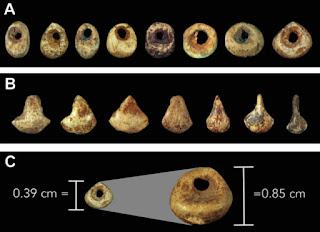 |
| Basket-shaped beads made of mammoth ivory from sites of the French Southwest, culture known as the ancient Aurignacian, Late Paleolithic (after Heckel, 2018) |
Still on the topic of the sexual division of labor, other elements evoked raise questions. One thinks, for example, of small ivory beads known in large numbers in the Aurignacian culture about 37,000 years ago, about which a participant tells us that he was unable to reproduce them experimentally, unlike the small hands of his female students… And to conclude that the ornaments would therefore have been made and worn mainly by women. Isn’t this a somewhat hasty deduction, full of our western presuppositions attributing meticulous manual activities to little girls from a very young age ?
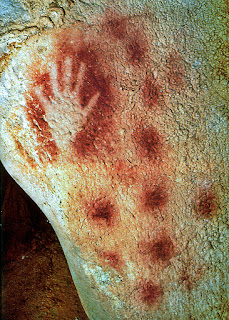 |
| Negative hand and punctuations of the cave of Pech Merle, culture known as Gravettian, Late Paleolithic |
The same would be true of at least part of the Paleolithic art, and one would hold for proof the famous negative hands affixed to the walls of the caves. The argument is based on the use of Manning’s index, which is supposed to determine the sex of individuals according to the proportions of their fingers. Twenty-four of the 32 negative hands studied would thus be female. Biological anthropology showed, however, more than ten years ago that this index could in no way be considered a reliable method for discriminating the sex of individuals who have left handprints in parietal art.
One could multiply the examples : in dealing with the crucial question of the sexual division of labor in this distant era, the authors systematically minimize its depth, when they do not suggest its pure and simple absence. As for the ways in which it would then be instituted to be shared, with certain remarkable constants, by all the hunter-gatherers of the world that have been observed during the last centuries, it is a question that will remain unanswered, for lack of having been asked.
Abduction of women, polygyny and matriarchies
When the book Lady Sapiens evokes a possible male domination in this type of societies, it is under two main angles : that of the polygyny and the abduction of the women.
One thus reads that the abduction of women “probably does not correspond to an anthropological reality” (p. 88). The rest of the text certainly tempers this assessment, and one speaker concedes that it may have been observed, while minimizing its scope. In the end, the reader is left with the feeling that while abduction was not totally unknown to these populations, it remained exceptional and that it was in any case hardly significant of gender relations.
In fact, the abduction of women (most often carried out individually and not collectively) is one of the most banal realities of ethnology, and it has been amply documented in hunter-gatherer populations, including those of aboriginal Australia.
One can of course emphasize the possible overestimation of abduction by the first ethnologists or by colonial opinion. But its existence does not lessen the fact that men had unilateral rights over women — the fact that, in some cases, the latter were consenting reveals that the possibility of a legal divorce was closed to them. As for the fact that it was nowhere the preferred mode of marriage, it reflects much more the prevalence, among men, of legal transfer procedures, than the matrimonial freedom of women.
Let us also note, in a broader way, the idea according to which “as a general rule, the societies of hunter-gatherers have every interest in maintaining a peaceful way of life, inside as well as outside their group” (p. 81) hardly fits in with the very numerous ethnological observations which attest to the contrary.
The other aspect mentioned is that of polygyny — that specific form of polygamy in which it is the man who has several wives. Polygyny, especially if it is high, expresses the unequal nature of the relationship between men and women as well as the relationship between men themselves. It is therefore surprising to read about it :
There are few cases of polygamy among hunter-gatherers. One knows cases of polyandry in Amazonia, but they are caused by catastrophic situations as the demographic fall of the women. (…) The ethnography of the hunter-gatherers shows us that the preferred form of relationship is monogamy. It is what suits best a society where one cannot be too numerous… (p. 90)
This way of portraying things is, to say the least, very skewed. If one had a statistic — which is not the case — on the number of unions in hunting and gathering societies, it would probably indicate that a majority of these unions are monogamous. But if one looks at societies that allow and practice multiple unions, the picture changes dramatically. According to the Ethnographic Atlas (the largest anthropological database), only 16 of the 178 societies listed in which hunting and gathering provided the bulk of the diet prescribed monogamy. Moreover, in the vast majority of cases, polygamy was open exclusively to men — in technical terms, these societies legitimized polygyny, but not polyandry. On this point, Lady Sapiens thus obscures reality in two ways : on the one hand, by minimizing the scope of the phenomenon, and on the other hand, by evoking it only in its most marginal form, and thus passing over in silence that which could suggest male domination.
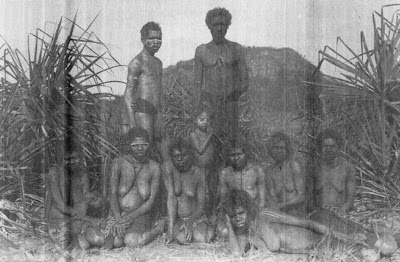 |
| A Mangaridji family (Northern Australia), photographed in 1912 by B. Spencer. The man (center) possessed at least six wives |
In the same vein, one also reads that, although rare, authentic matriarchies would be well and truly attested : for proof, “the Minangkabau of Sumatra and the Yanzi of Zaire” (p. 214). However, if these two peoples are matrilineal, and if the Minangkabau are well known for their matrilocality, neither of the two societies can seriously be qualified as “matriarchal”, and for good reason : unless the meaning of the words is twisted, such a configuration, in which women would have held power over men, has never been observed anywhere on the planet — such a universal does not fail to refer to the causes and mechanisms of male domination.
The forgotten male domination
Perhaps more than the elements that are written or shown, it is those that are omitted that contribute to forging a biased image. Indeed, once minimized or dismissed the sexual division of labor, the abduction of women and polygyny, the authors can affirm without restraint that Lady Sapiens “was unquestionably a woman of action” and, possibly, a “woman of power” (p. 203). The women of the Palaeolithic were not only “generous, skilful, daring and willing” (p. 241), so many flattering epithets, but which in reality say nothing about their social position ; they also enjoyed a “privileged status” (p. 203) — the documentary states that they were “respected, honoured, venerated”.
However, the key question, although never really addressed, is that of male domination, observed in the vast majority of human societies — including most hunter-gatherers. This domination was expressed with particular vigor in matters of matrimonial and sexual rights, the husband being able to lend or repudiate his wife at will, while she had no equivalent rights. In many of them, the social superiority of men was further legitimized by initiation religions, where they were informed of secrets that no non-initiated person, child or adult woman, could be informed of without incurring the death penalty.
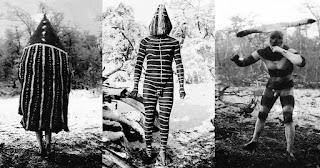 |
| Selk’Nam (Ona) Indians from Tierra del Fuego, photographed at the beginning of the 20th century by Mr. Gusinde. During the Hain ceremony, intended among other things to perpetuate the male domination, they embodied different spirits to frighten the women and the children. |
Yet this is where the ethnographic comparatism of Lady Sapiens stops. Not a word is said about these practices, and thus about the possibility that they can be traced, in one form or another, back to this period. It would be easy to argue that the absence of archaeological traces rules out this possibility ; unequal sexual or matrimonial rights, like many social relationships, leave no material trace. In itself, the absence of direct archaeological evidence of male domination does not allow for any conclusion — Paleolithic skeletons are far too few in number for us to be able, for example, to study the sexual distribution of traumas, as has been done, for example, with the Australian Aborigines.
Let’s ask the question again : if, as Lady Sapiens suggests, Upper Paleolithic societies ignored male domination and women held a valued position because of their objective economic role, why has the situation changed all over the world and why has male domination been observed among most of the hunter-gatherers studied by ethnology ? What happened, and when ?
Actually, the message conveyed by Lady Sapiens is that women involved “in many daily activities, essential to survival” (p. 203) could not be dominated. The economic importance of women’s activities would thus be sufficient to exclude the possibility of their subordination — an idea explicitly developed in the interviews given around the work. This is a very naïve view, and one that is contradicted by the whole history of gender domination and, beyond that, of the exploitation of labor. One only has to look at our own society to see that doing useful work is not a guarantee of recognition, and even less of social power.
Conclusion
In the end, the narrative that Lady Sapiens weaves from the data of science stages a modernized version of the myth of primitive matriarchy ; but where childbirth was supposed to have given women a pre-eminent place, it is now their productive activity that would have ensured the paleolithic equality of the sexes. In this light, this distant past — supposedly uniform for millennia and from America to Eurasia — looks strangely like the future to which contemporary feminists rightly aspire, up to a “very possible (…) management of sexual identities (…) much more open and tolerant (…) than nowadays” (p. 202). In reality, this is hardly the most likely hypothesis. Insofar as the immense gaps in the archaeological documentation can be informed by ethnological observations, it is on the contrary much more likely that the same causes having produced the same effects, human societies of the Late Paleolithic were characterized both by the sexual division of activities and by more or less marked and more or less formalized levels of male domination. To claim the contrary is undoubtedly seductive, as have been all the theories proposing in one way or another a lost golden age of relations between the sexes. But for science as for women’s emancipation, the most seductive theories are not necessarily the most correct and, therefore, the most useful.
Anne Augereau, Neolithicist, Inrap, PréTech laboratory
Fanny Bocquentin, archaeo-anthropologist, CNRS researcher, ArScAn laboratory
Bruno Boulestin, anthropologist, University of Bordeaux, PACEA laboratory
Christophe Darmangeat, social anthropologist, lecturer, University of Paris, LADYSS laboratory
Dominique Henry-Gambier, anthropologist, honorary director of research CNRS, University of Bordeaux, PACEA laboratory
Jean-Loïc Le Quellec, prehistorian, emeritus director of research CNRS, Institut des Mondes africains
Catherine Perlès, prehistorian, professor emeritus, University of Paris-Nanterre, PréTech laboratory
Nicolas Teyssandier, prehistorian, CNRS researcher, TRACES laboratory
Priscille Touraille, social anthropologist, CNRS researcher, eco-anthropology and ethnology laboratory