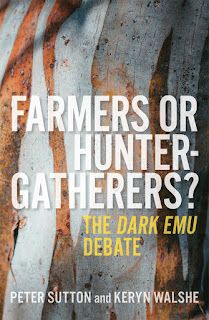
The recent publication of Peter Sutton and Keryn Walshe’s book, Farmers Or Hunter-gatherers ? The Dark Emu Debate, probably marks a major turning point in the debate going on in Australia since the publication in 2014 of Bruce Pascoe’s book, Dark Emu. With all their erudition and authority, these two colleagues have drawn up an implacable charge against the distortions, omissions or outright falsifications that underpin the thesis of Aborigines allegedly cultivating or even herding.
I do not withhold some disagreement with certain aspects of the book, in particular its rejection of any notion akin to social evolution or the idea that agriculture constituted progress ; but these discussions belong to what could be pompously called the philosophy of history. On a strictly factual level, the book is a reference and a rock that reminds us that a spade is a spade, that the prerequisite of any discussion — and of any real emancipatory will — is not to distort reality.
Sutton and Walshe’s reply has only been published for a few weeks, but it seems to have already caused a stir, with several journalists being led, with commendable honesty, to swallow their hats and admit publicly that they had, to put it succinctly, been taken in for the right cause — or for what they thought was one (for example, the very famous Ian Warden.
As my name appears from time to time in the debate because of the post I wrote in January 2020 on this subject, I feel this is an opportunity to republish it, this time in English. If I had been specifically addressing the Australian audience at the time, I might have written some of it a little differently. I have chosen to give here a translation that remains faithful to the original text.
Review of Bruce Pascoe’s Dark Emu
First published in French, 4th january 2020
Note : having read Dark Emu in the electronic form of a Kindle document, I could not mention the pages of the quoted passages. I will of course gladly indicate their location more precisely on request.
If the publication of Dark Emu has remained almost unnoticed in France, this book has been, in Australia, in addition to a tremendous success in bookshops (more than 100,000 copies have apparently been sold), a real social phenomenon. Awarded various prizes and nominations, it seems well underway to become a reference in the teaching of history. As one can imagine, such a resonance cannot be explained by the mere innovative character of the theses it defends : the theses in question still have to be sympathetic (in the physical and metaphorical sense of the term) with strings that are just eager to resonate. In this case, beyond the question of reevaluating the past accomplishments of Aboriginal groups, this narrative is at the crossroads of two major issues : the sustainability of the economic and ecological trajectory on the one hand, and the appalling legacy of the colonial conquest on relations with contemporary Aboriginal communities on the other.
I will come back at the end of this post to the political dimensions of the debate, as they obviously cannot be overlooked. Bruce Pascoe, as well as his opponents, is also raising the flag on this issue — he claims aboriginal ancestry, among other things. The debate has thus crystallized between the supporters of Dark Emu, whose contours espouse those of the so-called socially progressive camp, and his opponents, often virulent, who do not hide their conservative views. Quite significantly, I will also come back to this, the academic world seems to have hardly manifested itself, whether to defend the book or to attack it. I think I can guess some good reasons for this. But first things first : before coming to the intentions of each side, it is necessary to examine the theses of Dark Emu, and the elements on which they are based.
The Aborigines were not hunter-gatherers…
This is indeed the — obviously provocative — thesis defended in this book. Bruce Pascoe intends to demonstrate that the traditional vision of the Aborigines as nomadic hunter-gatherers was forged by the colonizer in order to legitimize his control over a Terra nullius, i.e. a territory not without inhabitants, but without a recognized owner (in the eyes of the one who wanted to seize it, obviously). In so doing, one would have distorted the reality of a significant part of the aboriginal tribes who, to varying degrees, practised agriculture, particularly in its irrigated form (chapter 1), aquaculture (chapter 2), lived sedentarily in fixed habitats (chapter 3), stored their food on a significant scale (chapter 4), and used systematic firing to manage the grass cover and the renewal of plant and animal species (chapter 5). The final chapters of the book focus on how the characteristics (real or assumed) of traditional Aboriginal societies could and should be put into practice to provide solutions to the problems faced today by Australian society.
None of the evidence presented by Bruce Pascoe is really new. It is based both on archaeological discoveries and on the early accounts of some Western observers that have long been published and available. It can even be said — and Bruce Pascoe himself readily confesses this — that the material in the book, from its main theses to the examples provided, is overwhelmingly indebted to the work of Rupert Gerritsen, an independent researcher who died in 2013, who argued in a number of texts that certain Aboriginal groups practised a genuine form of agriculture. While Gerritsen’s reasoning could be contested, and was at times harshly criticized, on the other hand everyone agrees in praising the honesty and rigour with which he presented his case. Unfortunately, the same cannot be said of Dark Emu, who, handling hyperbole and superlatives much more readily than nuance and the conditional, inextricably mixes perfectly proven elements, other possible but more dubious ones, other highly improbable ones, and finally straightforward affabulations, handling concepts and facts with disarming carelessness.
Social anthropology and prehistory have long known that, in terms of both technique and social structures, the traditional dichotomy between the wandering hunter-gatherer and the sedentary cultivator and storekeeper is a very crude and insufficient approach to reality. To begin with, the transition to agriculture, however rapid it may have been, necessarily involved intermediate stages and therefore situations that one must try to apprehend at best with a vocabulary always somewhat unsuitable (hence the expressions, for example, “semi-sedentary” or “proto-agriculture” found in scientific publications). Moreover, agriculture, sedentary life and storage did not necessarily go hand in hand : and the case of the hunter-gatherers formerly known as “complex” is particularly well known, especially those of the North-West Coast who, without engaging in any form of agriculture, were nonetheless villagers (sedentary) and storers. Significantly, Bruce Pascoe almost never raises these issues. The existence of hunter-gatherers practising storage is mentioned only once, at the turn of a page, without the possibility that some Aboriginal tribes even fall into this category being examined. As for the existence of mixed or intermediary forms between hunting-gathering and agriculture, or between nomadism and sedentary life, there is never any question of this : if, according to Bruce Pascoe, the settlers wanted to force the Aboriginals into a box, they should be taken out of it and forced into the other. And to serve this objective, all means are good. We will have a first glimpse of this with the double enormity according to which :
Several of these villages have proven to be the oldest in the world, a discovery that suggests Aboriginal people also invented society.
And one wonders who, from Bruce Pascoe or the colonists of past centuries, stood out with the most crass prejudices about hunter-gatherers ?
Small — and large — arrangements with the facts (1) :
Sources, eels, cakes and mills
To evaluate each element put forward by Bruce Pascoe and, in particular, to identify any cases of slippage or outright deformation, an entire book would be required. Since I cannot, of course, undertake such an exercise, I will limit myself here to a few points that I consider particularly important or significant.
As a general rule, one should begin by noting the way in which he chooses to give to his readers the means to verify his assertions. Apparently, in fact, the reference apparatus and the bibliography are imposing ; as this is a relatively short work, intended for the general public, there is no doubt that this effect is achieved, and that it conveys an impression of erudition and seriousness. Nevertheless, as soon as one tries to make a more careful check, this impression dissipates and gives way to a completely different feeling.
To begin with, a lot of information remains without any source. One could cite dozens of cases. For example, an old Aboriginal man from the Yuin tribe allegedly told George Robinson, an early colonial official, that they too practised agriculture, without it being possible to know where to find the terms of this surprising dialogue. As for the researcher who “claims that the Garden Range Aboriginal rock-art site in the Strathbogie Ranges of Central Victoria (…) depicts the activity of herding and farming kangaroos.” he too will remain unknown to the reader, as will the title of the work advocating such an original interpretation. No more will be known about this “complex village site in ‘Australia’s dead heart’”, an archaeological site that is said to be under study and “where the people had a complex water-management system, sophisticated housing, stone quarries, and seed-grinding and storage arrangements”. Etc.
The problem of missing references is compounded by the fact that of those provided, a considerable number are second-hand. Of the 263 reference notes, Rupert Gerritsen alone accounts for no less than 23. Why not give directly the sources on which he relied ?
But where the book’s lack of rigour borders on outright dishonesty is when it shamelessly distorts the information to suit the purpose it is intended to serve. Examples abound, which various critics (not always well-intentioned, but that’s another problem) have not failed to point out. I will mention just a few of them here.
The first one is certainly not central to its purpose, but it is revealing. Speaking of the fish traps found near Condah Lake in southwest Victoria, Bruce Pascoe writes :
Escaped convict William Buckley visited Condah Lake before 1836, and praised the quantities of fish caught there. He also saw several other devices for fishing on smaller streams at various locations west of Port Phillip Bay.
Since Buckley’s memoirs are famous for the quality of their ethnological information, which dates back to the early years of settlement, it is not difficult to see that no such information is included. Pascoe’s reference in support of this passage is not Buckley’s account but, strangely enough, an article in The Age newspaper. Could Pascoe have inadvertently copied the wrong information ? Nay. William Buckley’s name appears in the article only incidentally, to point out that he mentions eel fishing — without using any trapping devices. So it is indeed Pascoe who allows himself to embroider and invent details that will give his story more color and appeal.
The second example has already been extensively commented on by critics of Bruce Pascoe. It is the way Dark Emu renders certain episodes from the stories of the explorers Charles Sturt and Thomas Mitchell. This aspect is all the more crucial as these two sources constitute the major pillars of his developments (in fact, of Gerritsen’s): Pascoe keeps coming back to them, mentioning their names 52 and 57 times respectively in the course of the text. It would be unreasonable to enumerate all the problematic restitutions of these narratives contained in Dark Emu, but I will mention just a few.
The first concerns the episode in which the explorer’s party, overwhelmed by heat and fatigue, was rescued by a group of Aborigines. Sturt speaks of a group of 300 to 400 people — at the time of the encounter, he counts the adult males around him as 69 individuals. Welcomed into their camp (this is Sturt’s term), he and his men were offered a place to stay, water, some roast ducks and cakes. This cake is actually made by baking flour from wild grains harvested by the Aborigines. During the evening, the women were “the women being employed beating the seed for cakes, between two stones, and the noise they made was exactly like the working of a loom factory”.
In the words of Bruce Pascoe, the cakes were “the best that [Sturt] had ever tasted”, a fact that will be sought in vain in the original text. As for the grinding of grain by women, probably not modern enough, it becomes nothing more and nothing less than “the whirring of hundreds of mills”!
By the way, the grinding of wild seeds into flour and the making of cakes gives rise to a serious slippage. Having noted the age of Australian grindstones, some of which date back 30,000 years, Bruce Pascoe lets out a cry of triumph :
This makes these people the world’s oldest bakers by almost 15,000 years, as the Egyptians, the next earliest, didn’t bake until 17,000 BC. (…) Why don’t our hearts fill with wonder and pride ?
On a strictly personal level, I confess that I feel neither shame nor pride that the baking of grain, the levalloisian flint knapping, the writing, the zero, the butter-cutting wire or the atomic pile were discovered in one part of the world rather than somewhere else ; and I willingly leave such feelings to “happy idiots who were born somewhere” [title of a French song]. But it seems that the desire (recurring throughout the book) to make Aborigines the champions of precocity does not promote objectivity. To begin with, although one might think that the two phenomena are linked, the dating mentioned by Dark Emu does not concern the cooking of the cakes strictly speaking, but the grinding of the grains by means of stones. However, various European and Asian sites have provided similar dates — the current ‘record’, held by a tool from an Italian cave, equals the antiquity of its Australian counterparts.
Moreover, the obsession to hoist the Aborigines on the highest step of the anteriority podium leads him, on the basis of a single discovery for which many conditionals are required, to slash the most commonly accepted dates of their arrival on the continent, namely about 50,000 years, to add a few tens of millennia. And, for good measure, to sweep aside the date on which archaeologists commonly place the significant transformations that led to technical progress and an “intensification” of production (as the term is used), i.e. about 4,000 years ago : all this, according to Pascoe, is considerably older. And since what is ancestral can only be good, he “suspect[s] there are elements of agriculture, conservation, culture, and government that, having been tested against the nature of Aboriginal society for a minimum of 80,000 years, hold profitable messages for the nation”.
Small — and large — arrangements with the facts (2) :
Villages of 1000 inhabitants… and more !
On another occasion, again according to Bruce Pascoe, “Sturt had seen a sophisticated village of seventy domed huts on the Darling River, each capable of housing up to fifteen people”, this statement being illustrated by the following excerpt from Sturt’s diary :
[The houses] were made of strong boughs fixed in a circle in the ground, so as to meet in a common centre ; (…) They were from eight to ten feet in diameter, and about four and a half feet high, the opening into them not being larger than to allow a man to creep in.
Expressed in modern units, the dimensions of the dwellings were therefore 2.50 to 3 meters in diameter and 1.40 meters high. Anyway, that’s enough for Pascoe to house 15 people ! And that’s not all : the beginning of the sentence, censored in the quotation reproduced by Dark Emu, who mentions 70 houses, actually refers to “seven or eight huts”. Since it is highly unlikely that such a gross mismatch between the quotation and his commentary is due to a double blunder by the author and the publisher (this is the second edition of a book that has already sold several tens of thousands of copies), the only explanation that Pascoe’s commentary actually applies to another passage from Sturt, which he also quotes elsewhere (see below). Its addition to a truncated quotation that does not correspond to it in any way is only meant to give the illusion that the descriptions of villages in Sturt’s account are more numerous than they actually are.
The presence of numerous villages of 1000 inhabitants – Bruce Pascoe even uses the term “towns” repeatedly, and against all rigor – which would have been observed on several occasions, is indeed one of Dark Emu’s key arguments. But since no such concentration has ever really been observed (a few very rare cases at most raise doubts), the thesis requires a favourable presentation of the facts, to say the least.
The only excerpt in which Sturt provides information that supports Pascoe’s argument is therefore this one :
On the 5th, the river led us to the southward and westward. Early in the day, we passed a group of seventy huts, capable of holding from twelve to fifteen men each. They appeared to be permanent habitations, and all of them fronted the same point of the compass.
It should be noted, however, that such an observation, which concludes to a maximum accommodation capacity of a thousand people, calls for a minimum of caution : while the existence of permanent and, most probably, regularly occupied constructions is indisputable, it is quite possible that these constructions were not all occupied at the same time, or that they were occupied only during a limited period, for example during the harvest of a particularly abundant seasonal resource.
Concerning the explorer Thomas Mitchell, Pascoe’s other major source, the evidence is not much more conclusive, despite his claim that he expressed “astonishment” at the size of a Queensland settlement :
[Mitchell] counts the houses, and estimates a population of over one thousand. He’s disappointed that nobody’s home ; it’s obvious they have only just left, and the evidence is everywhere that they have used the place for a very long time.
The corresponding passage in Mitchell’s diary is as follows :
We had this day noticed some of their huts which were of a very different construction from those of the aborigines in general, being large, circular, and made of straight rods meeting at an upright pole in the centre ; the outside had been first covered with bark and grass and then entirely coated over with clay. The fire appeared to have been made nearly in the centre ; and a hole at the top had been left as a chimney. The place seemed to have been in use for years as a casual habitation.
The rest of the excerpt describes objects that were in huts deserted by their inhabitants, which Mitchell says were most likely fled when they arrived. Neither wonder, then, nor counting – regarding the supposed age of occupation, we see how easily Pascoe transforms the years evoked by Mitchell into centuries or millennia.
In fact, in Mitchell’s entire diary, the one and only passage to which Pascoe’s words could be applied is the one dated June 11. As can be seen, the information is much less dramatic than he claims :
From the number of huts along the riverbank it was obvious that the inhabitants were numerous, and I was therefore the more surprised that our depot could have continued so long near them without their discovering it.
But one cannot close this chapter without mentioning the passage in which Pascoe draws an estimate that surpasses all the others. This concerns the shores of Lake Condah, the very shores that have yielded the remains of stone walled dwellings. We learn that “around 10,000 people lived a more or less sedentary life in this town”. To hell with greed ! Thus written, the sentence seems to be a reiteration of ideas put forward by the archaeologist who excavated the site, Heather Builth. But there is no clear reference to this (Builth, obviously a second-hand quote, is not included in the bibliography). In fact, the figure of 10,000 people put forward by Builth (and itself perhaps questionable) did not estimate a sedentary, “urban” population, but the number of potential individuals that could be fed at temporary gatherings by fish caught in the dams built for that purpose.
Agriculture, aquaculture and storage : an attempt of synthesis
It is not possible, without unreasonably lengthening this account, to sift through all of Dark Emu’s assertions ; but the whole presentation suffers from the same shortcomings. With the praiseworthy motive of rehabilitating certain Aboriginal achievements that are often ignored, the text presents a partial, biased, if not frankly fanciful image of them. What, then, of the three major dimensions of Bruce Pascoe’s thesis : storage, aquaculture and agriculture ?
Throughout the world, with the exception of a few particularly favoured (and very generally coastal) environments, storage is a major factor in sedentary lifestyles : it makes it possible to reduce mobility where resources are partially or totally lacking at certain times of the annual cycle. Contrary to what the author suggests throughout Dark Emu (and the same reproach could be addressed to Gerritsen’s original book), storage is however by no means a marker of agriculture : just as there are agricultures without storage (in particular those based on tubers in equatorial environments), there are hunter-gatherer economies based on more or less important storage — such was the case of the famous ethnographic example of the North-West coast of the American continent. There is evidence that some of the Aboriginal tribes practised storage to some degree (especially in the Darling and Murray River region). But, as with the size of the villages, Pascoe exaggerates and distorts the sources by repeatedly having them say that these stockpiles reached or exceeded one ton. This figure, if true, would still be relatively modest ; but in almost all cases, archaeological and ethnographic evidence argues for smaller sizes. Moreover, and contrary to what the book suggests, there is no evidence allowing to link these stocks to agricultural practices. Everything indicates that they were made up of wild plants, yams or grasses, sometimes harvested en masse in certain favourable locations — to which must be added the possible, but unproven, existence of smoking and drying of fish in certain places, such as Lake Condah. With the possible exception of the Darling region (but here the evidence is extremely tenuous), there is no serious support for the idea that some of these reserves would have been used for anything other than deferred consumption and that they could have been sown, following the traditional pattern of cereal farming. The most reasonable interpretation of these arrangements is therefore that they represent a “certain” degree of sedentariness and stockpiling among the tribes concerned, as do many other hunter-fisher-gatherers observed in other parts of the world.
The presentation of water management devices is even more biased. The Aborigines had built two broad categories of structures. First, there were ‘fish traps’, the most monumental of which being those at Brewarrina. Trenches were dug and stones piled — obviously a considerable amount of work, given the scale of the project — to allow fish to be forced through and easily caught by guiding them into shallow pools. These devices, which were moreover regularly maintained, clearly made it possible to catch large quantities of fish at certain times of the year, or even to allow a certain number of individuals to live permanently in their immediate vicinity (which certain ethnological sources seem to accredit). However, we do not see what authorizes the collection of these works under the name of “aquaculture” — a choice that is not at all a slip of the tongue, since it is nothing less than the title of the chapter in question ! The fish were neither fed nor cared for, and their reproduction was not controlled in any way. On that account, the Solutrean hunters who guided herds of wild horses into pens or to cliffs to kill them more easily should be called breeders !
The other category of achievements is represented by dams, sometimes intended to retain water, sometimes to force it to spread over large areas in order to irrigate them and promote plant growth. Here again, it is by no means a question of underestimating the work accomplished, nor the knowledge that such achievements implied. But here again, words and categories must retain their meaning if they are to be reasoned with. To speak, as Bruce Pascoe repeatedly does, of irrigated agriculture in terms of a device that promotes the growth of wild plants (or, through it, the presence of game) is nothing but an abuse of language — and even more so when the device in question, however ingenious, is intended only to retain water so that humans can drink.
As has been said, Gerritsen’s plea for genuine Aboriginal agriculture in some places was based on some very real evidence : in some areas, it has been proven that the Aborigines, when harvesting yams, knew how to cut out a piece of it and plant it immediately. As well, the way in which they extracted these tubers was a certain preparation of the soil that encouraged regrowth. Sowing practices, for their part, remain, depending on the case, hypothetical or rather limited. The existence of such practices, particularly in the Darling River area, where wild millet was harvested and then threshed on a large scale, remains a mere possibility, which there is no convincing evidence to confirm. Harry Allen’s 1974 article on the mosaic of peoples living in this area raised the question of why these tribes had never taken the step that would have led them to genuine agriculture — defined, in particular, as the domestication of the wild species Panicum decompositum.
In fact, while Gerritsen has had the merit of bringing to light a number of plant manipulation practices, one need not follow him when he forcefully draws these practices under the umbrella of full-fledged agriculture. His definition, which excludes in particular the criterion of domestication, but includes that of harvesting (whereas the harvesting of wild species is nothing other than what is usually called gathering), is coined for this purpose. But if, as Beth Gott (who is keen to express herself in a rigorous and nuanced way) writes about the handling of yams, “the distinction between ‘harvesting’ and ‘cultivation’ seems less abrupt than one might think”, this does not mean that it can be erased. In Australia, and essentially in relation to two regions, we can at most speak of proto-agriculture, or emerging agriculture. But, apart from the relative scarcity of evidence of these practices, it is significant that those consisting in preparing the soil and taking care of plants during their growth, for example by weeding, are nowhere mentioned, nor is there any trace of even rudimentary animal husbandry.
The other dimension of Pascoe’s argument is the role – the importance of which, by contrast, is unanimously recognized, although in detail it continues to be discussed — of the regular burning of parts of the Australian landscape in the millennial shaping of the environment and the renewal (or selection) of species. This point, which had already been made through Gerritsen, was recently developed in Bill Gammage’s book, which reminded us of the importance of this practice, which an archaeologist called, as early as 1969 with a certain sense of the formula, “fire-stick farming”. But “fire-stick farming” is not really “farming”, unless one twists the meaning of the words.
In reality, the problem may lie less in the identification of these practices than in their more general interpretation, along the multiple pathways that have led from hunting, fishing and gathering to agriculture and animal husbandry. Simply ignoring them is obviously not an option. But, for all that, including them at all costs in the category of agriculture for reasons that owe little to science and much to a particular political agenda can only trap the discussion in a sterile dilemma. There is certainly much to learn from the Australian case, provided that it does not involve it in false issues. The fact that the hunter-gatherers of this continent — for they were indeed hunter-gatherers — acted on their environment in ways and on a scale that have long been underestimated, may indeed lead to the conclusion that they must, as a result, be considered as quite (or very) special hunter-gatherers. This may be the case. But it is also questionable whether the question is simply not being asked properly, and whether our understanding of the hunter-gatherer norm is not heavily influenced by the fact that those we know best in ethnology lived either in desert environments or in dense forests, i.e. in environments where their environmental impact was necessarily quite limited. To this we must add the archaeological bias, which means that for the best known prehistoric periods, everything that is organic and vegetal is very poorly preserved. For these reasons, and no doubt for a few others as well, the image we have formed of “typical” hunter-gatherers is probably distorted in favour of hunting, and our perception of their economy is strongly tilted towards passive predation — are they not classically opposed to the only “real” producers, which would be the farmers ? But the achievements of the Aborigines — if seriously discussed, which Pascoe’s book does not allow — suggest that in temperate zones at least, the hunting and gathering economy may have had a quite significant impact on the environment, an impact that was partly conscious and maintained by voluntary practices and which, in turn, greatly affected the resources available to these peoples.
Finally, it should be noted that Dark Emu only very incidentally addresses Aboriginal social structures. For someone who is anxious to demonstrate that these societies possessed all the post-Neolithic technical attributes, this may seem surprising. In reality, from his perspective, it is better to avoid this slippery slope : how in this case to avoid thinking that with agriculture, irrigation, sedentary life and storage, material privileges and inequalities of wealth had appeared, as was the case everywhere else in the world ? Researchers who have argued in favour of the ‘complexity’ of certain Australian societies have rarely failed to cite the few ethnographic testimonies (highly dubious by the way) that point in this direction, namely those of Stähle and Dawson on the Gunditjmara of the Lake Condah region. Bruce Pascoe, who is so inclined to use all means possible, does not use this ready-made argument, for one simple reason : his aim is to idealize not only the technical achievements of the Aborigines, but also their social relationships. Therefore, it is certainly not a question of bringing the worm of social inequality with the fruit of technical development. From Aboriginal societies, we will therefore simply learn that they were a model of democracy, and that they “did construct a system of pan-continental government that generated peace and prosperity”. For those who are familiar with the reality of these societies, these assessments lie somewhere between exaggeration and frank fabrication.
Finally, a little (a lot) politics
As I said in the introduction : with Dark Emu, Bruce Pascoe also (and above all?) pursues political objectives. These are displayed as such : according to him, the vision of the Aborigines as hunter-gatherers not exploiting the land would have contributed to forge the argument of Terra Nullius which legitimised colonisation. Even more, he continues to do so :
The insistence on using the hunter-gatherer label is prejudicial to the rights of Aboriginal people to land.
The belief that Aboriginal people were ‘mere’ hunter-gatherers has been used as a political tool to justify dispossession. Every Land Rights application hinges on the idea that Aboriginal and Torres Strait Islander people did nothing more than collect available resources, and therefore had no managed interaction with the land ; that is, the Indigenous population did not own or use the land.
I am very far from knowing enough about the local situation to know how much truth there is in these statements. It is obvious that the overall situation of the Aborigines has for two centuries been an open wound in the body of Australian society, which no measures have so far managed to heal. And it is equally obvious that the demands of Aboriginal communities in terms of land rights, which have been asserted in recent decades, represent financial stakes that are too high for the possessors not to oppose them outright.
My first movement is that there is still some naivety (feint?) in believing that, in itself, the recognition of real or supposed agricultural practices among Aborigines would change anything fundamental to the problem. The fact that the Aborigines were to a very large extent hunter-gatherers probably provided a convenient pretext for their dispossession by the Westerners. But, as far as is known, the existence of agriculture never stopped any colonisation in the world, on any continent whatsoever. To take just one example, North America was, at the time of contact, populated, depending on the area, by hunter-gatherer or farming societies, the latter sometimes being very dense. As for Africa, it was almost entirely agricultural, and moreover organized in States. In what way did this protect the populations from the greed of the conquerors ?
In fact, Bruce Pascoe’s mistreatment of the facts is due to his reasoning as a nationalist — a nationalist who is both Aboriginal and Australian. Like any nationalist, he is keen to glorify the past of the group to which he belongs ; and if the past does not lend itself willingly enough to such glorification, he mythologizes it a little, a lot, or passionately. As for the role he dreams of for the Aborigines, it is certainly not to contribute to the overthrow of the capitalist social order, but to integrate into it, and to take their share of the cake — much more appetizing, no doubt, than the one once offered to Sturt. When Pascoe writes that “It’s not the difference between capitalism and communism ; it’s the difference between capitalism and Aboriginalism”, make no mistake : what is aimed at by this maxim is not capitalism, but communism. Because, you see, if only we listened to what the Aborigines have to say, capitalism in general, and Aboriginal capitalism in particular, would be fine. Speaking of the grain once harvested by the tribes of Australia and how it could be grown today, Pascoe exclaims :
There’s no contemporary market for these grains, but I bet a stall in any city market could sell flours from these grains at premium prices to whole-foods enthusiasts. Markets are created by entrepreneurs. Set aside a few paddocks and have some fun, and I’ll eat my boot if it doesn’t yield a profit.
The nail is driven in a little further :
Our aim is for one, or a group, of the young local Aboriginal people to turn the results of this investigation into a profitable industry.
And if Paris was indeed worth a Mass, the Sydney, London and Wall Street stock exchanges would, according to Bruce Pascoe, have everything to gain by drawing inspiration from the spirituality that permeated (and still permeates) the Aboriginal communities :
In Aboriginal life, the spirit and the corporeal world are wedded ; but in European society, the economy operates independently of the spirit and, as modern examples illustrate, almost in defiance of the religious moral code. The financial crash of 2009 and the oil spill in the Gulf of Mexico in 2010 occurred because the Christian morality of most participants had been excluded from their business dealings.
Throw away The Capital and open the Gospel according to Saint Bruce : Mass is said.
There remains one last question, perhaps the most painful : how can it be explained that the Australian progressive camp, as far as I can judge from my computer screen, has almost unanimously chosen to sing the praises of a work that mistreats facts so carelessly, promotes the supernatural as a moral guide and the capitalist enterprise as a political perspective ? And why are the main, if not the only, voices that arise to denounce imposture those of reactionaries with the worst intentions ?
I can see no other answer than that which, for the same causes, produces the same effects in our latitudes : many feel paralysed at the idea of criticizing anything that comes from the oppressed and, through misguided solidarity, give up fighting for reason and social emancipation. Once again, I have no knowledge of Australia other than books. But I think I can imagine the social pressure represented by the appalling fate of the Aborigines, and the difficulty of proposing an independent path, between following the communitarianism of both sides. This powerlessness is, moreover, taking on the appearance of disarray, if I am to believe this university publication , which is intended as a reference guide for training teachers, to enlighten them on the question of “appropriate” and “less appropriate” (or even downright “offensive”) terms in relation to Aborigines.
Some passages raise a smile. Others are frankly perplexing, such as the one explaining that the term “prehistoric” should not be used in relation to traditional societies, because “Use of this term denies the validity of Indigenous Australian history before what is commonly regarded as written history, and before European contact. It also denies a place for Aboriginal people in history”. With such an unstoppable logic, it seems to me that we must immediately stop talking about prehistory in relation to Lascaux, except to seriously offend the Magdalenians or those who would consider themselves their descendants.
But the best — or rather, the worst — is yet to come. We learn that when talking about the origins of human settlement on the continent, it is “appropriate” to use the phrase “since the beginning of the Dreamtime”, as this phrase “reflects the beliefs of many Indigenous Australians that they have always been in Australia, from the beginning of time, and came from the land”. It is “less appropriate” to say that “Aboriginal people have lived in Australia for 60,000 years”, as this duration “puts a limit on the occupation of Australia and thus tends to lend support to migration theories and anthropological assumptions. Many Indigenous Australians see this sort of measurement and quantifying as inappropriate”.
In such a context, why should we be surprised by the concert of praise that accompanied Dark Emu ? No doubt many progressives say that bottle of historical narrative is not important, so long as you get the drunkeness of solidarity with the Aboriginal cause. But when it comes to recommendations to teachers and the rapturous reception given to Bruce Pascoe’s book, what emancipation can come out of such renunciations ? In the meantime, one thing is certain : it is not with bad conscience that one makes good science.